
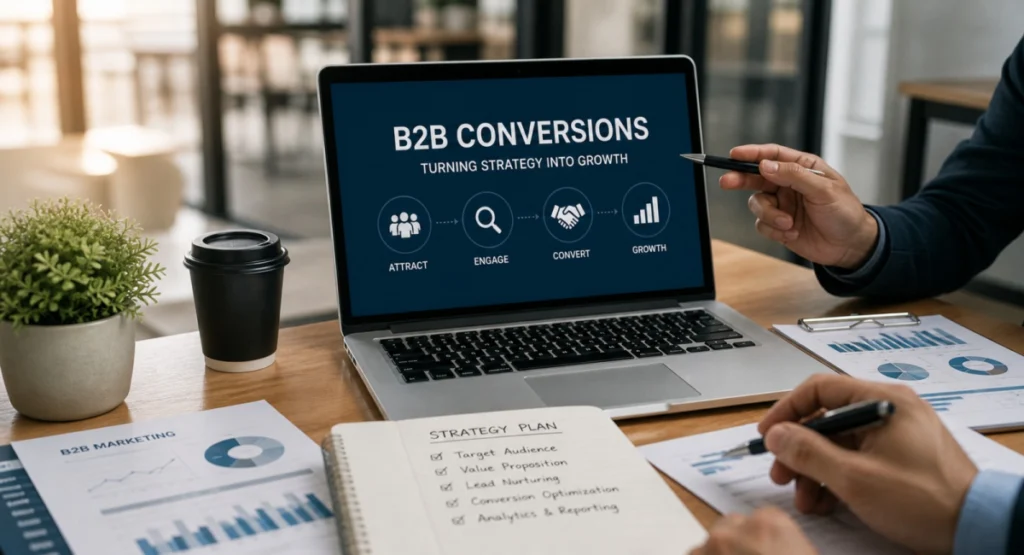
In today’s competitive digital landscape, B2B conversions end up being the critical metric of performance for companies selling services or products to various businesses, but despite investing closely in advertising campaigns, paid advertising, and revenue teams, many companies often fail to deliver results.
The main problem isn’t a stable price range – it’s strategy. Unlike the B2C market, B2B consumers are more rational, information-driven, and cautious. They take time, involve more than one stakeholder, and require consensus before a decision can be made. Therefore, improving B2B conversions requires a deeper understanding of the customer journey, not just surface level methods anymore.
Let’s explore why most businesses struggle—and how you can address these issues.
The Real Reasons Behind Poor B2B Conversions
Lack of Clear Target Audience
The most common mistake companies make is trying to target every single person. When your message is just too big, it won’t resonate with anyone. This directly affects B2B conversions because decision-makers don’t think the experience is understood.
For example, a SaaS company offering a CRM software might target “all businesses”. But a small startup and a large business have completely different desires. Without segmenting your target audience, your campaigns are meaningless.
How to renew it:
Create an in-depth Ideal Customer Profile (ICP). Define:
- Come
- Company Size
- Budget Diversification
- cause pain
When your messaging aligns with a specific target market, your B2B conversions will obviously increase.
Weak Value Proposition
Your payment proposal is the first thing a potential customer evaluates. If it’s vague or overwhelming, you immediately lose potential. Many organizations say, “We provide the best solutions,” which doesn’t understand them.
Imagine the companies:
- One says, “We offer virtual marketing services”.
- Another says, “We help SaaS organizations grow proven leads with 40% help in 90 days.”
Which sounds extra compelling?
A strong payment proposition directly increases B2B conversions by making your offer clean and attractive.
Case studies:
A UK-based whole advertising business company has carried out its landing and page messages through effects specialist with preference for services. In 60 days, their B2B conversions increased through 35% combined by rewriting their title and value proposition.
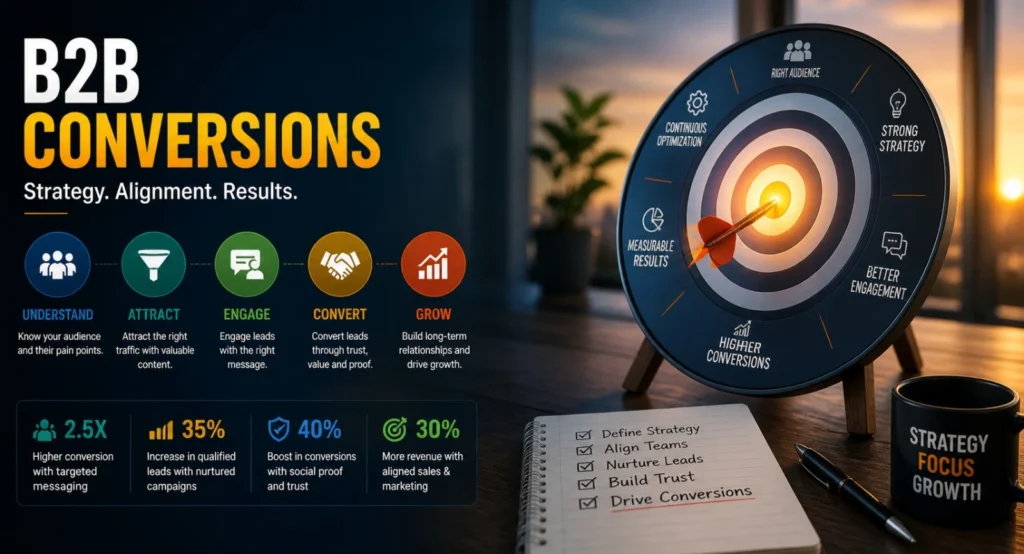
The Role of Marketing Funnels in B2B Conversions
No Structured Funnel Strategy
Many groups capture immediate impact without guiding users through the journey. But B2B Conversions require nurturing over time.
A proper funnel includes:
- Top of the funnel (TOFU): Blog posts, SEO, social media
- Middle of the funnel (MOFU): Case studies, email series
- Bottom of Funnel (BOFU): screenings, consultations
Example:
A software recruiter started offering unbound webinars to Focus level prospects. These webinars educated clients and professionalized the organization. As a result, their B2B Conversions progressed through 28% in 3 months.
Poor Lead Nurturing
Not enough to generate leads. Many companies fail because they don’t follow up properly. Leads require more than one touchpoint before they can be converted.
Real International Example:
One B2B mobile publisher noted that most executives no longer convert. They conducted an electronic mail feeding series involving:
- Educational Resources Resources
- Customer Fulfillment Stories
- Individual Offers
This easy strategy doubled their B2B conversions within six months.
Solution:
Use CRM tools and automation to consistently connect with leads. Time and relevance are key.
Website Optimization and Its Impact
Slow and Confusing Website Experience
Your internet site plays an important role in influencing B2B conversions. If it’s gradual or difficult, visitors will leave before they get to work.
Example:
An e-commerce B2B platform reduced website load time from five seconds to 2 seconds. This change automatically increased B2B conversions by 20%.
Best Practices:
- Optimize web page speed
- Use a smooth layout
- Ensure mobile responsiveness
- Make navigation easier
Lack of Clear Call-to-Actions (CTAs)
A common mistake is not always telling users what to do next. Without a clear leadership, the outlook will not change either.
Instead of:
- “Present”
- “Click right here”
Experiment:
- “Get Your Free Consultation”
- “Book a showing now”
Strong CTAs keep friction and manual customers away from converting, increasing B2B conversions exponentially.
The Importance of Trust and Credibility
No Social Proof
In B2B marketplaces, consideration is the whole point. Decision makers need certainty before investing money. Without social proof, your B2B Conversions will be few and far between.
Example:
A consulting firm sponsored buyer testimonials and case studies on the website. Within a few weeks, they saw a 25% increase in B2B conversions.
Types of Social Proof:
- Testimonials
- Review
- Case Research
- Customer Marks
Weak Brand Authority
If your logo doesn’t look credible, people will hesitate. Authorization plays a key role in influencing B2B conversion.
Example:
The LinkedIn-centric approach helped build authority by helping B2B reps share a lot of insights. Over time, inbound leads increased and B2B conversions improved.
Solution:
- Publish Valuable Content
- Share industry insights
- Engage with your audience
Data-Driven Decisions for Better Results
Ignoring Analytics
Without statistics, you’re guessing. Many companies fail because they don’t sing the entire performance effectively.
Key Requirements:
- conversion value
- cost per lead
- The bounce rate
- The pipeline is satisfactory
Example:
One employer determined that most conversions came from natural traffic, not paid advertising. They’ve shifted finances as a result and bolstered B2B conversions to lower fees.
Not A/B Testing
Small adjustments can lead to big improvements. Performance can be optimized by testing different elements.
Example:
Landing pages that evaluated headlines led to a 15% increase in B2B conversions.
Examination:
- The title
- The pictures
- CTA
- Page Layout
Sales and Marketing Misalignment
Lack of Communication
When inbound ad groups are misaligned, leads fall through the cracks. This distance reduces B2B conversions.
Example:
An organization prioritized each team by defining clear expectations and communication channels. This further improved conversions by US and B2B with 22% adoption.
Poor Lead Qualification
Not all leads are the same. Without proper filtering, sales teams waste time on low-quality prospects.
Solution:
- Use management steps
- Defining Educational Standards
- Focus on Over-Intent Leaders
Better B2B conversions paid better attention to results.
How to Fix B2B Conversion Problems
Focus on Personalization
Personalization is no longer optional. Tailored messaging greatly improves B2B conversions.
Example:
One company customized email campaigns based entirely on company stakeholders. This led to higher engagement and better conversion rates.
Invest in High-Quality Content
Content is one of the most powerful tools for driving B2B conversions.
Examples of effective content:
- Blog posts
- White Papers
- Case Studies
- Webinar
Case studies:
A SaaS system produced in-depth information that addressed customer pain factors. These guides attracted qualified traffic and advanced B2B conversions through 30%.
Conclusion
Improving B2B conversions takes more than just running ads or generating leads. It requires a strategic approach that focuses on knowing your audience, building acceptance as true with, and optimizing each step of the buyer journey.
Most businesses fail because they neglect fundamentals like brainstorming, messaging, and follow-up. But with the help of imposing the right strategies—personalization, strong funnels, and fact-driven decisions—you can turn things around.
Remember, fulfillment in B2B conversions isn’t always small wins. It’s mostly consistency, experimentation and non-stop development.
Pingback: Who Really Needs SEO and Why It Matters – therankupsolution