
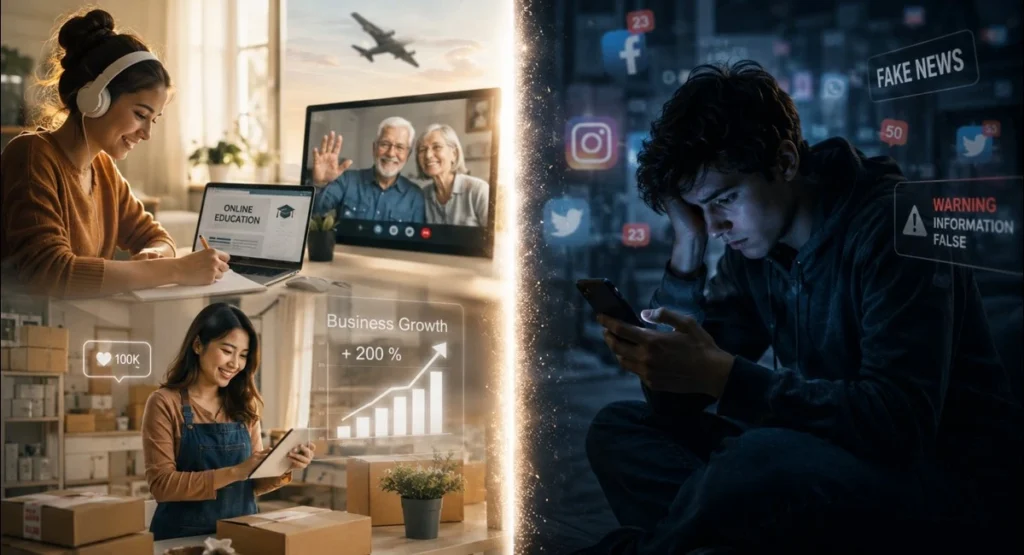
Social media has changed the way billions of humans interact, consume, and interact with the region. From Facebook and Instagram to TikTok and LinkedIn, those systems weave themselves into everyday life. But as their influence grows, so does the controversy over their influence.
Understanding the pros and cons of social media is crucial for absolutely anyone navigating their current lifestyle. This article takes a balanced look at what social media offers — and what it takes away.
The Power of Connection: Bringing People Together
Pros and Cons of Social Media The most well-known advantage of any dialogue is its ability to engage people far and wide across cultures.
Global identity and community building
Before social media, maintaining a long-distance relationship took a lot of effort. Today, a grandmother in Pakistan can video-call her grandchildren in Canada, and a researcher from rural India can access academic circles around the world. Forums like Facebook groups and Reddit have enabled groups of interests to flourish — from rare disease guide activities to interest groups — giving humans a sense of ownership that could never be placed regionally
Reconnecting with lost relationships
Social media also serves as a powerful tool for rekindling older relationships. Childhood friends rediscover each other after a long time, and estranged participants in their own families reconnect through an appropriate friend request whenever possible. This social glue is one of the biggest emotional resonance benefits highlighted in any analysis of the pros and cons of social media.
Information and Awareness at Your Fingertips
The speed at which facts travel through social media is dazzling. What once took hours to reach the general public now stretches out in seconds.
real-time news and crisis communications
Social media has been confirmed as a life-saving tool during emergencies and general fitness emergencies. During the COVID-19 pandemic, fitness companies used Twitter and Facebook to provide critical real-time management. Activists have used Instagram and TikTok to record protests and draw international attention to human rights issues, making those systems the world’s fastest-changing news outlets.
educational materials and capacity building
YouTube courses, LinkedIn learning, and academic TikTok have democratized information in a way that textbooks absolutely should not. In a small metropolitan area, a young person can fully learn programming, cooking, or a new language through unbound social media content. If we analyze the pros and cons of social media, this democratization of education is one of its best valued achievements.
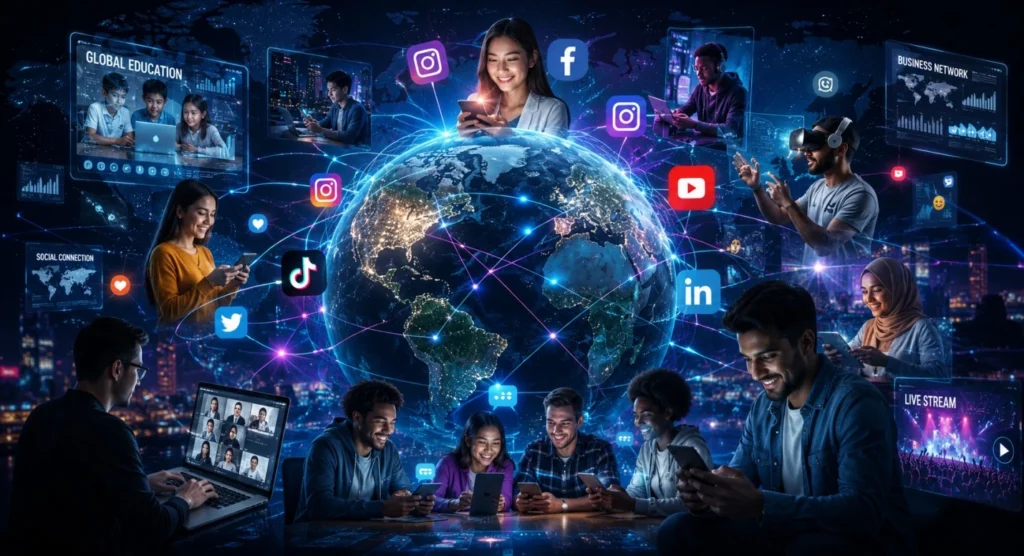
Business, Marketing, and Economic Opportunities
Social media isn’t just a social tool – it’s a financial engine that has transformed entire industries.
Small Business Growth and Brand Visibility
Independent entrepreneurs and freelancers have found a level playing field on social media. A home baker can build hundreds of followers on Instagram; A homemade earring artist can reach an international clientele through Pinterest. Facebook Ads and TikTok’s author marketplace have given small groups a targeting tool once reserved for large agencies.
The Rise of the Creator Economy
Social media has led to the creation of a whole new profession: the content writer. Influencers, YouTubers, and virtual teachers now earn full-time income from structures that compensate them primarily based on engagement. This author’s economic system is actually worth loads of billions of dollars globally — experienced purely within the pros and cons of the social media debate.
Mental Health and Psychological Risks
No honest assessment of the pros and cons of social media can overlook its dark effects on psychological beauty.
Anxiety, Depression, and Social Comparison
Multiple studies have linked excessive social media use to anxiety, depression, and loneliness — especially for young adults, social feeds expose users to the spotlights of other lives: good bodies, extraordinary developments, glamorous careers. This constant comparison undermines shallowness and breeds feelings of inadequacy. Research in journals like JAMA Pediatrics has consistently flagged social media use as a contributor to the decline in adolescent mental health.
Addiction and Dopamine Manipulation
Social media platforms are intentionally designed to be addictive. Likes, comments, and information trigger the release of dopamine in the brain — the same pathway activated by gambling use. The endless scrolling and algorithmic feeds are designed to maximize screen time. Many customers are recording compulsive checking behavior and stress while apart from their phones — serious downsides to pros and cons of the social media equation.
Misinformation and the Erosion of Truth
A risky consequence of the rise of social media is its effectiveness in spreading false statistics on a large scale.
Viral misinformation and casualties
From anti-vaccine content to political disinformation, social media platforms have struggled to ingest harmful lies. The COVID-19 pandemic has confirmed how quickly misinformation can spread and shape public behavior in dangerous ways. Algorithms that prioritize engagement over accuracy often boost sensational content rather than truth.
Echospace and Polarization
Algorithmic curation promotes ideological echo chambers — zones where customers only come to views that confirm their existing model. Over time, this narrows views and deepens social divisions. The polarization seen in many democracies today has been partly attributed to the filtering of bubbles created by social media, including another extreme contrast in the advantages and disadvantages of social media dialogue.
Privacy, Data, and Security Concerns
Behind every free social media platform is a statistical chain tool that raises serious ethical questions.
Surveillance Capitalism and Data Exploitation
Social media groups are storing huge amounts of personal records — surfing behavior, location, shopping habits — and making money off them through targeted advertising and marketing. The Cambridge Analytica scandal discovered how statistics can be weaponized for political manipulation. This erosion of digital privacy is one of the most pressing concerns within social media communications execs and cons.
Cyberbullying and Cyberbullying
The anonymity of social media has become a fertile ground for cyberbullying and harassment. Victims can receive heaps of abusive messages within hours. For younger customers, cyberbullying can lead to academic decline, social withdrawal, and permanent psychological damage — a truth that the platforms struggled to adequately cope with.
Conclusion
The pros and cons of social media reflect a generation that is neither inherently good nor terrible — yet extremely powerful. It has connected continents, democratized knowledge, built economies and amplified unheard voices. At the same time, it has contributed to demanding conditions for intellectual freedom, political polarization, violations of privacy and misinformation.
The key lies in intentional use. For individuals, this means setting up barriers to screen time and approaching structures with crucial cognition. For companies, this approach allows the consumer to be prioritized in the right way – to be expected by engagement. For governments, it approaches smart regulation that protects residents by stifling free expression. Truly, expertise is the first step to accurately using the pros and cons of social media.