
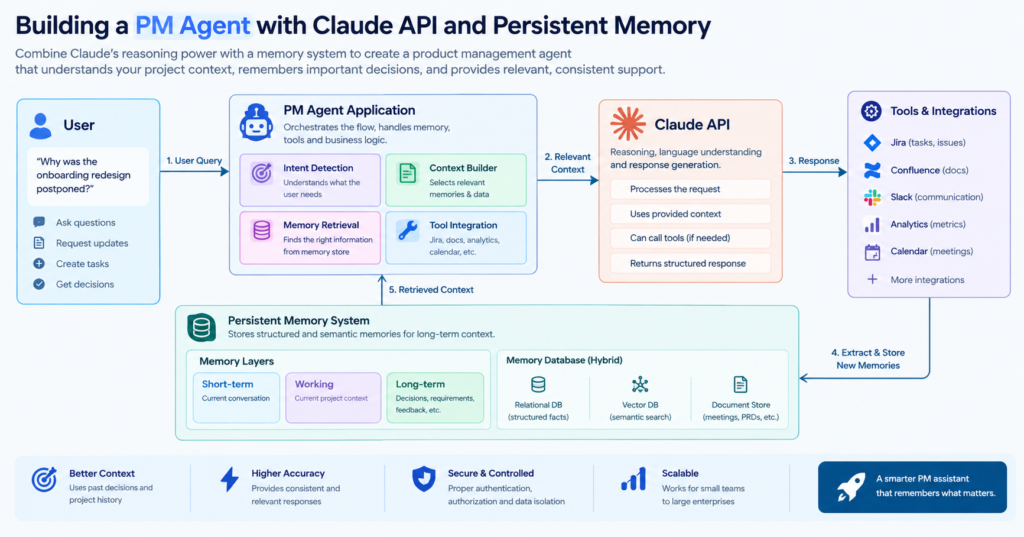
Artificial intelligence is changing how product managers plan, organize and run projects.Modern AI agents can look at requirements, keep track of tasks, write summaries of meetings and help teams make decisions.One strong way is to build a product management agent with Claude API memory persistence. This mixes Claude’s language power with a memory that stays saved.
Unlike a chatbot that forgets earlier chats a product management agent with memory can hold onto key project details and use them later.This makes building a product management agent with Claude API memory persistence helpful, for long‑term product development because context and past decisions matter.
Understanding the PM Agent Architecture
What Is a PM Agent?
A PM agent is an AI- assistant built to handle product management tasks. It helps with writing product requirements, organizing backlogs spotting risks, creating project updates and answering questions about product choices.
When building pm agent with claude api memory persistence the Claude API acts as the core reasoning and language-processing engine. The agent takes in user input, sends it to Claude for processing and then returns responses that consider the current project context. This way the agent can keep track of conversations and decisions to provide more accurate and consistent answers over time.
Why Memory Persistence Matters
Memory persistence lets the agent keep information beyond one conversation. I see, for example a product manager might tell the agent that a specific feature is planned for the release. Weeks later memory persistence allows the agent to bring that information up again when the agent talks about release planning.
This is one of the benefits of building a PM agent, with Claude API memory persistence because product management needs a continuous context instead of separate conversations.
Connecting Claude API to the PM Agent

Setting Up Claude as the Intelligence Layer
You can add the Claude API to a program that keeps track of user requests and project details. Your program sends prompts and background to Claude and the agent takes care of the extra logic.
When you build a project manager agent, with Claude API memory persistence it is essential to stop sending all history with each request. Instead the application should fetch the memories that matter for the present task.
Creating a Memory Workflow
A practical workflow begins when a user sends a message. The system looks for information, checks the memory database and finds related project context. That context is then added to the Claude API request.
Once Claude gives a response the application can decide if new information needs to be stored. This gives a learning-like experience without making the model remember every conversation permanently.
Designing Persistent Memory
Types of Information to Store
I find that a PM agent can store types of memories including product requirements, customer feedback, project decisions, deadlines, team responsibilities, meeting summaries and unresolved issues.
When I build a PM agent with Claude API memory persistence I find that storing information is often more useful, than saving complete conversations. Structured memories make retrieval faster. Help reduce irrelevant context.
Choosing a Memory Database
The memory part can be built using a database, a document system or a vector database based on what the application needs. A vector database can help when the agent needs to search for meaning in a lot of data.
The purpose of creating a PM agent, with the Claude API and memory storage is not just to save everything. The purpose is to save information and bring it back when it is needed.
Improving PM Agent Performance
Using Relevant Context
A powerful project manager agent should know which memories matter for a question. For example if the user asks about a product feature the system should focus on memories connected to that feature instead of bringing up other project details.
Getting the information is therefore a key part of creating a project manager agent using the claude api with memory storage.
Managing Memory Quality
Memory quality can significantly affect agent performance. Memory quality that is incorrectly outdated or duplicated can cause responses. Developers should consider adding timestamps, source information, confidence levels and update rules to stored memories. A good implementation of building a pm agent, with Claude API memory persistence should also provide mechanisms for updating or deleting memories.
Security and Privacy Considerations
Protecting Product Information
Product management data is sensitive. Product management data may contain business strategies, customer information and internal decisions. When building pm agent, with claude api memory persistence developers must implement authentication, authorization, encryption and appropriate data-access controls.
The pm agent should only retrieve information that the current user is authorized to access.
Controlling Long-Term Memory
Persistent memory should not become an uncontrolled archive. Teams should establish rules for what information can be stored and how long it should remain available.
This makes building pm agent with claude api memory persistence safer and easier to maintain as the application grows.
Conclusion
Building pm agent with claude api memory persistence can transform a basic AI assistant into a long-term product management partner. By combining Claude API capabilities with a carefully designed memory architecture, organizations can create agents that understand project history, remember important decisions, and provide more contextual assistance.
The most effective approach to building pm agent with claude api memory persistence focuses on relevant retrieval, structured memory, security, and continuous maintenance. Rather than storing every conversation, developers should build a system that identifies valuable information and makes it available when needed.
As AI-powered product management continues to evolve, building pm agent with claude api memory persistence offers a practical way to create intelligent assistants that remain useful throughout the entire product lifecycle.