
Approximately how a successful digital product is perceived is not the best. It should be well
understood, simple to navigate, and useful to the people involved. This is where the ux design
process rome proves critical for modern businesses looking to build rom higher websites,
apps, and virtual objects.
UX design is generally actions through exploration, defining user needs, wireframing,
prototyping, testing, and refinement. It’s also an iterative system, which means designers can
also return to the range early on if experimentation reveals new issues or opportunities.
What Is the UX Design Process?
The ux design process rome refers to the dependent techniques used to capture customers,
identify problems, create solutions, and enhance digital stories. Rather than designing screens
without delay, UX professionals must first try to understand what users really want.
Understanding User Needs
The first qualification focuses on users and their preferences. Designers can observe user
behavior, conduct interviews, evaluate current website statistics, and study the competition.
This research allows companies to avoid making the simplest design choices at all based on
assumptions.
defining the problem
After the survey, the designer prepares the statistics and perceives the main problems to be
solved. Clear disruption definitions help teams focus prosecution efforts on critical
improvements.
Research and Discovery
Consumer Research
Designers can use interviews, surveys, analytics, user feedback, and price tracking to
understand how humans interact with the product.
The intention is to understand the expectations, frustrations, motivations and general
responsibilities of users.
Competitive Research
Studying competing websites and packages may not reveal unusual styles and opportunities for
differentiation. However, copying competitors is not the goal. The motivation is to capture the
market and find out how we can create better joy.
Creating User Flows and Wireframes
Mapping User Flows
User flows show the steps a person takes to complete an action, such as developing an
account, ordering a supplier, purchasing a product, or submitting a form .
A clean float allows the designer to identify unnecessary steps and complicated instructions.
Wireframe Development
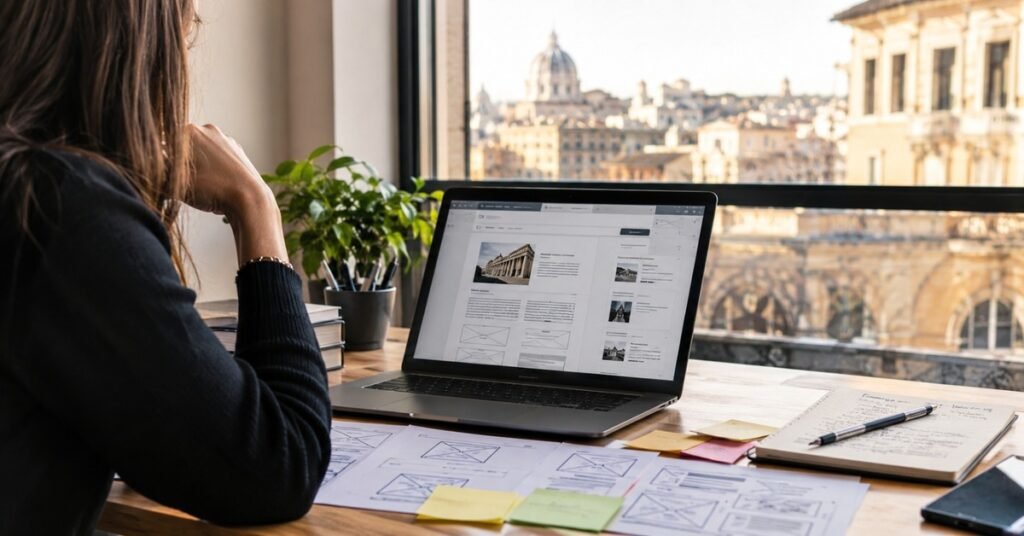
Wireframes provide the basic structure for the pages of evolution before the specific visual
design begins. They focus on design, hierarchy, navigation, and placement of content material.
This training allows teams to address structural issues before spending some time on visual
information.
Usability Testing and Feedback
Testing With Real Users
Designers can give users specific tasks and observe how they interact with a prototype or
website. Their behavior and feedback can reveal navigation problems, unclear content, and
difficult interactions.
Improving the Design
Testing results should lead to practical changes. Designers may simplify a form, change
navigation, improve content hierarchy, or redesign an interaction.
UX is iterative, so testing and refinement may happen multiple times throughout a project
Development and Design Handoff
Working with developers
Designers provide manufacturers with the very latest displays, specifications, components,
assets, and interaction information. Allowing close interaction ensures that the final product
matches the intended enjoyment.
Check the final product
UX diagrams do not necessarily hinder the beginning of development. Designers can evaluate
the implemented product to be aware of the differences between the layout and the actual
interface.
This final assessment can help maintain consistency and usability
Conclusion
UX design process rome presents an established way for companies to create virtual surveys
primarily based on real person needs. From reading and teasing definition to wireframes,
prototyping, testing and development, each phase contributes to the very last revel in.
The only UX efforts aren’t just focused on attractive interfaces. They combine user needs with
business goals and continuously improve the product primarily based on evidence and
feedback.
After a clean ux design process rome, ROM can create websites and digital products that are
simpler to use, more attractive, and better aligned with customer expectations.